


Multiplex Education
Graduate Certificate in
Program Overview
This 12-month certificate is a rigorous foundational holistic education course of study that brings traditional Islamic knowledge and practice into dialogue with contemporary educational theory and practice to better prepare teachers in the emerging field of contemporary Islamic Education.
The students learn about:
Traditional Islamic knowledge, the venerable tradition of the dars-i nizami educational system, and futuwwah practices.
Best current theory and practice in the field of contemporary education (pedagogy, curriculum design, teacher training, etc.).
How to transform their existing subjects, lessons, and practices to align with the spirit of Islamic knowledge and education while integrating innovative contemporary theories and practices.
Being a flexible online program, our program boasts a team of expert faculty members from all over the world who are well-versed in the traditional Islamic sciences and education and contemporary educational theory and practice. It also brings together diverse, yet like-minded students from diverse countries, creating a rich classroom experience infused with real-life examples of contemporary issues and debates.
The course load of 1 course per term allows students to further their education without interrupting their regular work or family commitments. After completing this certificate, students will have the opportunity to further explore, study, and research by enrolling in additional education courses that we will be rolling out in 2026.
Why Multiplex Education?
Over the past decade, there has been an explosion of interest and a growing number of publications on topics related to Islamic Education. Alongside the growth in the literature, this period has also witnessed the increased establishment of Islamic schools and conferences, symposiums, and courses on Islamic Education. Such an interest for Islamically-oriented educational theory and practice continues to grow alongside the interest in the new generation of Muslim educators who desire supplementary training in Islamic knowledge and the rich tradition of Islamic Education to incorporate into their teaching and research. Muslims have become dissatisfied with merely importing Western ideas and models to their countries and communities and are in search of truly Islamically-rooted answers to the educational challenges. Furthermore, the broader field of education is also looking to add diverse voices and perspectives to the discourse.
Multiplexity (Maratib)
Multiplexity refers to the multiple ontological, epistemological, and methodological layers, levels, and approaches to the study of reality. It postulates the multiple levels of being to which correspond epistemological modes of knowing and multiple methodological approaches for each modality.
Yet there is a dearth of programs that can adequately address this urgent ummatic need. While some programs in Islamic Education do now exist, none offer an integration of traditional Islamic perspectives and values with contemporary educational theory and practice like our Multiplex Education Certificate. Usul Academy aims to address this urgent need.
Who Should Apply? Who is the program aimed at?
The certificate is designed to be appealing to a wide spectrum of Muslims working on the broad area of education:
1. Teachers; Educators working in Islamic schools and non-Islamic schools
2. Home educators who are educating their own children at home (homeschooling).
3. Leaders, school principals, and school administrators working in Islamic schools or with Muslim students.
4. Imams and coordinators of Islamic Studies programs at schools.
5. Curriculum designers/developers working in or for Islamic schools or Islamic curriculum projects.
6. Students with Islamic Studies Background (Dar al-‘Ulum or other) looking to work in the field of education.
Program Structure
The program is entirely online. The 12-month program is spread across 4 terms, 10 weeks each, except for Term 4 (July-August), which will consist of 5 weeks plus a 2-day intensive weekend. By the end of the program, graduates are awarded a Graduate Certificate in Contemporary Islamic Education*
*This is not a teacher certification program nor an accredited degree. It is meant to be a supplementary form of knowledge and training alongside your main accredited training program/degree.
Curriculum
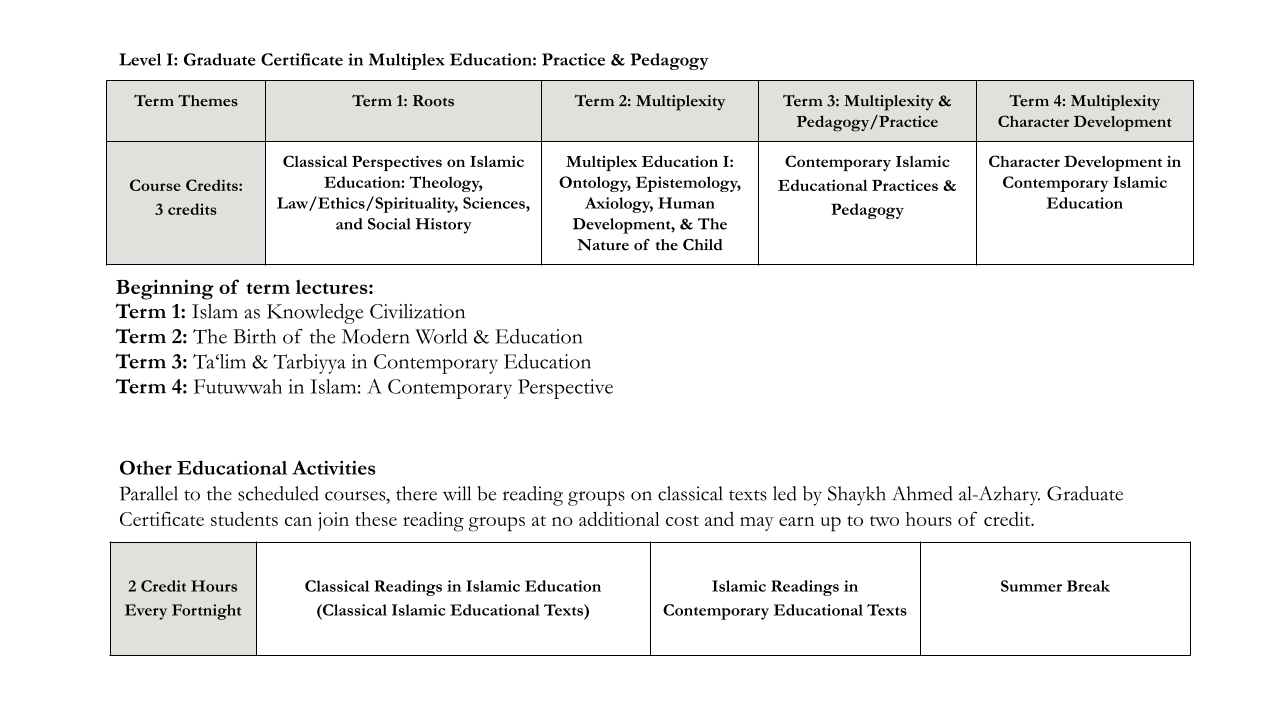
Prerequisites
Priority will be given to educators working in a school or educational setting. Applicants currently enrolled in a BA in Education or equivalent teaching program are particularly welcome to apply. All applicants should also have a university-level command of the English language. While it is not a prerequisite, it is highly encouraged that students first complete our Diploma in Islamic Foundations or its equivalent (see courses on our website for this).
The program is designed as a stacked curriculum meaning that while the Graduate Certificate is a stand-alone degree, students who want to continue can add additional courses in the future and obtain a higher degree.
Program Particulars
Students are expected to watch a 1.5-hour pre-recorded video every week Monday through Friday. On Saturday or Sunday, there will be a live 1.5-hour online discussion session on that week’s pre-recorded video. Although the language of instruction is English, students will be exposed to Arabic terms in translation to build up an Islamic vocabulary of key concepts and ideas. In addition to the videos and classes, students are expected to engage in 3 hrs of self-study per week.
Online Pre-recorded videos: 1.5 hrs
Online Weekly Live Discussion Sessions: 1.5 hrs
Self-Study: 3hrs
Total Hours: 9 hours/week
Each term will start with a general Term Seminar (2 hours) delivered by Dr. Recep Senturk or a guest speaker.
Term 1: Islam as Knowledge Civilization
Term 2: The Birth of the Modern World & Education
Term 3: Ta‘lim & Tarbiyah in Contemporary Education
Term 4: Futuwwah in Islam: A Contemporary Perspective
Term 4 will be 5 weeks summer term followed by a 2-day weekend intensive.
Capstone Project & Real-World Impact:
Despite the program’s theoretical richness, it also has a strong practical focus. Students will be expected to choose something from their own work (a lesson plan, a course they teach, an educational text they are writing, etc.) and use it throughout the year as the material for their capstone project to be submitted at the end of the year. In every term, the students will be using what they have learned to further deepen, transform, and improve their own work. The program is designed so that students achieve a tangible outcome and have real-world impact.
Evaluations & Assessments
In addition to the Capstone Project, students will be expected to complete creative evaluations for each course. The assessments are designed to be creative, engaging, and students have the option of using their own existing work-related material (school lesson plans, texts, curriculum, etc.) This way, whatever work students complete for this course is directly relevant to their practice.
Program Faculty Members
-
Dr. Recep Şentürk is the president of Usul Academy and teaches Sirah; Riyah al-Salihin; 40 Hadiths of Imam Nawawi and Comparative Theories and Methods.
He currently serves as Dean of the College of Islamic Studies at Hamad Bin Khalifah University. He was the founding president of Ibn Haldun University (IHU) in Istanbul (2017-2021). He obtained his BA from The School of Islamic Studies at Marmara University and MA in Sociology at Istanbul University. He pursued his PhD in Sociology at Columbia University in New York.
He served as a researcher at The Center for Islamic Studies (İSAM) in Istanbul, and the founding director of the Alliance of Civilizations Institute. He is head of the International Ibn Haldun Society. He has published widely in English, Arabic and Turkish on a whole range of topics, including social theory and methods, civilization, modernization, sociology of religion, networks of ḥadīth transmission, Malcolm X, Islam and human rights, modern Turkish thought, and the life and ideas of Ibn Khaldūn. Among his books are: Narrative Social Structure: Hadith Transmission Network 610-1505; Malcolm X: The Struggle for Human Rights, and in Turkish; Open Civilization: Towards a Multi- Civilizational Society and World; Islam and Human Rights; Ibn Khaldun: Contemporary Readings; Malcolm X: Struggle for Human Rights; Social Memory: Hadith Transmission Network 610-1505. Şentürk’s works have been translated to Arabic, Japanese and Spanish.
-
Dr. Samir Mahmoud is currently Academic Director of Usul Academy
Recently he was Assistant Professor at the Lebanese American University. He has a BA (Hons) in Anthropology & Politics with a focus on multicultural theory and comparative religion, and an MA in Architectural History, Theory & Urban Design with a focus on the traditional townscape from the University of New South Wales, Sydney Australia. He also holds an MPhil in Theology & Religious Studies with a focus on comparative philosophy and aesthetics. He completed a PhD in Islamic Studies from the University of Cambridge under the supervision of Dr. Timothy Winter (Shaykh Abdal Hakim Murad). -
Dr. Claire Alkouatli is an academic, educator, mother, and life coach with a PhD in Human Development, Learning, and Culture from the University of British Columbia, in Canada, specialized in social and emotional development and qualitative research methodologies. Dr. Alkouatli is currently an Assistant Professor at Prince Sultan University, and a Lecturer with the Center for Islamic Thought and Education (UNISA), where she teaches a graduate-level course in Islamic pedagogy. With expertise in both adult and child development, she has designed and facilitated Saudi teacher education in English and designed playgroups for very young children centering culturally-relevant storytelling and imaginative play. Dr. Alkouatli’s qualitative research focuses on the roles of culture, relationships, and pedagogies in expanding human development across the lifespan, with specific focus on play, dialogue, inquiry, and challenge.
-
Shaykh Ahmed El-Azhary is a graduate of Islamic Studies at Al-Azhar University and a graduate of Anthropology at American University in Cairo. He received his training in Leadership Communication from Tulane University and The University of Alabama at Birmingham. His Islamic education began over twenty years ago and he holds over 100 Ijazas from scholars across the Muslim world, including an Ijaza of Iftaa’ and Teaching in Hanafi Fiqh from Shaykh Ali Salih al-Azhari.
Shaykh Ahmed’s contributions to the Islamic Philosophy of Education are both extensive and groundbreaking. One of his notable publications is al-Maṭāliʿ fī Ādāb al-Muṭāliʿ, a compendium of seven edited treatises on the art of deep reading. Another significant contribution by Shaykh Ahmed El Azhary to the Islamic Philosophy of Education is his work Iḥyā’ Sanad al-ʿIlm, a compendium of four pivotal texts authored by al-Shāṭibī, Ibn Buṭlān, Ibn Khaldūn, and al-Fārābī. This work delves deeply into the philosophy of Islamic education, exploring its foundational principles and practices. Beyond this, Shaykh Ahmed has authored and edited several classical texts. His works include: Rūḥ al-ʿIlm; Ghāyat al-Iḥkām fī Adab al-Fahm wal-Ifhām; Kifāyat al-Muḥaqqiq fī ʿIlm al-Manṭiq; Tashnīf al-Samʿ fī ʿIlm al-Waḍ; al-Ta’sīs fī Uṣūl al-Tadrīs.
-
Dr. Talal Al-Azem teaches Aqīdah and Hanafi Fiqh. Talal Al-Azem is the Mohammed Noah Fellow at the Oxford Centre for Islamic Studies, and the Islamic Centre Lecturer in Classical Islam in the Faculty of Theology and Religion of the University of Oxford. He studied the disciplines of Islamic learning in Syria and Turkey. He has written and lectured on the history and philosophy of Islamic education, as well as the history of Muslim jurisprudence. He is the author of Rule-Formulation and Binding Precedent in the Madhhab-Law Tradition (Brill 2017).
-
Omar Qureshi is the Director of Integrated Curriculum at Yaqeen Institute for Islamic Research. Prior to this, he was a lecturer (Western and Islamic Philosophy) and head of the Contextual Islamic Studies and Leadership (CISL) Diploma at Cambridge Muslim College. After obtaining his Bachelor of Arts in Microbiology, he went on to complete his M.Ed. in Curriculum and Instruction – Science Education both from the University of Missouri – Columbia. Later, he completed his Ph.D. in Cultural and Educational Policy Studies: Philosophy of Education at Loyola University Chicago in 2016. His dissertation, entitled “Badr al-Dīn Ibn Jamāʿah and the Highest Good of Islamic Education”, treats the topic of educational institutional identity in the United States. Prior to CMC, he served as the provost and assistant professor of Liberal and Islamic Studies at Zaytuna College. Omar also served as the principal and dean of academics for a parochial school located in Chicago’s West suburbs for seven years.
In the Islamic sciences, Omar has studied texts in Islamic Law – Shāfiʿī, Kalām theology, Islamic Legal Theory (usūl al-fiqh), Qurʾānic sciences and exegesis, Ḥadīth nomenclature, Prophetic Biography and Islamic History. Some of the courses Omar has designed and taught are Contemporary Muslim Thought, Metaphysical Foundations, al-Ghazālī, and Islamic Legal Theory (usūl al-fiqh).
-
Item description
-
Dr Farah Ahmed is Senior Research Associate at the Faculty of Education, University of Cambridge. She convenes the Cambridge Dialogues: Renewing Islamic Education theory into practice academic research network. Her research centres on using dialogic halaqah to develop shakhsiyah Islamiyah and this is translated into practice through the online international Islamic Educator Learning Community.
In 2002, Farah co-founded Islamic Shakhsiyah Foundation (ISF) which runs Shakhsiyah Schools. ISF grew out of homeschooling projects and for over twenty years, Farah has led the development of the Shakhsiyah Education Model, a holistic integrated approach to education that draws on classical Islamic educational thought and contemporary research. Farah served as head teacher for twelve years and is now Director of Education and the lead developer of Shakhsiyah Halaqah and Holistic Thematic Curricula. She is the author of Principles of Shakhsiyah Education and Dialogic Halaqah: A guide for the Muslim educator.
-
Dr. Nadeem Memon is an Associate Professor at the Centre for Islamic Thought and Education (CITE) at the University of South Australia (UniSA). At CITE/UniSA, Nadeem serves as a Curriculum Advisor for the Graduate Certificate in Education (Islamic Education), the first online graduate education program for educators in Islamic schools globally.
His research focuses on teacher education with particular emphasis on Islamic Pedagogy, comparative faith-based schooling, philosophy of religious education, and culturally responsive pedagogy. In his research program, Nadeem is a Chief Investigator on an Australian Research Council (ARC) Discovery Grant (2022-2025) on Culturally Responsive Schooling. He also leads a monthly reading group on Faith-Based Pedagogies with educators and academics from various religious traditions and religious orientations.
Some of his notable publications include a sole authored book entitled: A History of Islamic Schooling in North America: Mapping Growth and Evolution (Routledge, 2020) and four co-edited books:
(1) Curriculum Renewal for Islamic Education: Critical Perspectives on Teaching Islam in Primary and Secondary Schools (Routledge, 2021);
(2) Teacher Training and Education in the GCC: Unpacking the Complexities and Challenges of Internationalising Educational Contexts (Routledge, 2021);
(3) Philosophies of Islamic Education: Historical Perspectives and Emerging Discourses (Routledge, 2016);
(4) Discipline, Devotion, and Dissent: Jewish, Catholic, and Islamic Schooling in Canada (Wilfrid Laurier University Press, 2013).
In support of Islamic schooling, Nadeem serves the Board Chair for the Islamic Schools League of America (ISLA), member of Yaqeen’s Institute’s Curriculum Advisory Board; member of the Global Association of Islamic School’s conference committee; member of University of Cambridge’s Cambridge Dialogues on Rethinking Islamic Education and a consultant on Qatar Foundation’s Usul Education Framework.
Prior to joining UniSA, Nadeem was the Director of Education at Razi Education where he spearheaded the design and implementation of a groundbreaking online teacher certificate program, the Islamic Teacher Education Program (ITEP), in collaboration with the University of Toronto. Nadeem holds a PhD in Theory and Policy Studies in Education from the Ontario Institute for Studies in Education (OISE) at the University of Toronto, Canada. He currently lives in Adelaide, Australia with his wife and son.
Usul Academy is not accredited by any external organization. Usul Academy is self-accredited according to the time-honored tradition of the ijazah system of traditional Ottoman Madrasahs.